Weak or manual product recommendations
Turn browsers into bigger baskets, not just more clicks
Maestra Platform gives ecommerce teams a marketing personalization platform backed by a dedicated forward-deployed marketer, so recommendations lift AOV and items per order instead of sitting there unused.
Brands running on Maestra






The problem
A big catalog is supposed to be an advantage, not a maze
When a store carries thousands of SKUs across categories, customers can end up clicking three or four levels deep just to find something relevant. Recommendation engines built for smaller catalogs choke on that complexity and default to showing whatever is most popular, not what fits.
What we hear from brands
a craft-supplies retailer says customers must go three or four levels deep to find products across a vast catalog
an art-supplies retailer reports poor product recommendations due to a huge SKU catalogue
an apparel brand with a large catalog has underperforming recommendation engines and inadequate personalization for mixed subscriber and one-time customers
The new way
AI on autopilot, with business rules whenever you want the wheel
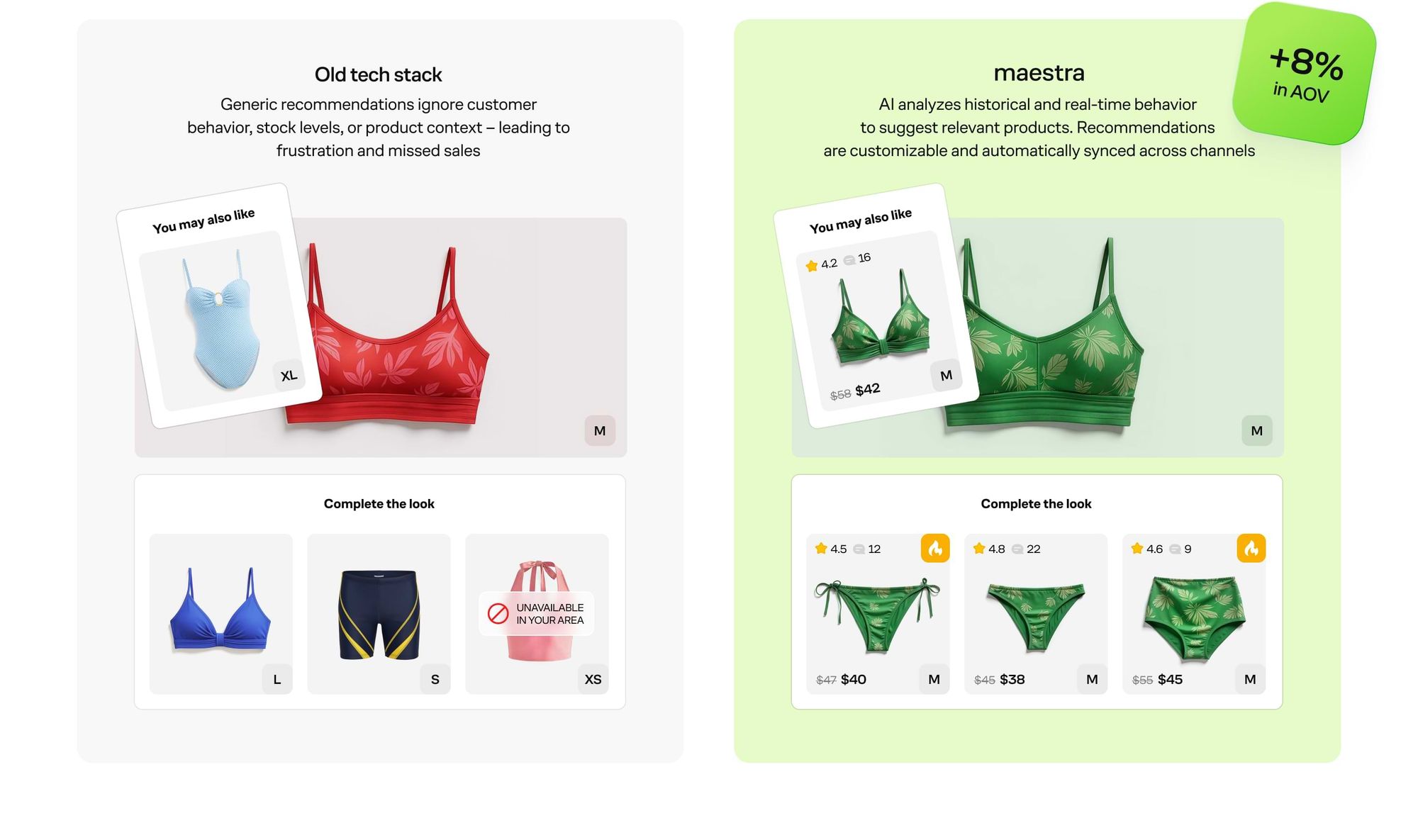
Recommendations can run entirely on Maestra's AI engine, picking products from your inventory automatically. Or your team can fine-tune by color, price, category, or collection with no-code business rules, so merchandising expertise and machine learning work side by side instead of competing.
Outcomes brands report
Customer proof
Defense Mechanisms taught its recommendation engine actual gear relationships

Customers struggled with product discovery across a tactical gear catalog until Defense Mechanisms implemented Maestra's dynamic recommendations, adapted to both customer behavior and the brand's own merchandising rules. Viewing a plate carrier now surfaces the right cummerbund, and browsing a rear bag surfaces compatible organizers.
8.9%
of sales influenced by product recommendations

“We can let the AI engine run on autopilot and pick products from our inventory. Or we can adjust it ourselves to match what we know works well together”
How it works
A migration timeline you can actually plan around
Approve the roadmap
Your forward-deployed marketer puts together a migration plan specific to your business and gets your sign-off before starting.
Build happens without disruption
Your current platforms stay live while the new setup is built, so day-to-day marketing does not pause.
Two to seven weeks to go live
Growing brands typically land in two to four weeks. Complex, nine-figure setups take three to seven, with warm-up for deliverability included either way.
The platform
One platform, ten modules, zero data silos
Instead of stitching together separate tools, Maestra runs your CDP, journeys, recommendations, and messaging from one commerce-specific data model. Every module reads and writes to the same customer profile, and the whole system handles 2M requests per minute at under 300 milliseconds.
Including
Your forward-deployed marketer
Four meetings a month, not one
Most platforms schedule a single monthly check-in, if that. Maestra's forward-deployed marketers run four meetings a month by default, because their account load is a fraction of the industry standard, leaving room for actual strategy work.
4 meetings a month versus 1 elsewhere
Fewer than 15 accounts per marketer, versus 60+
Strategy, migration, flows, and A/B tests done for you
Replace your stack
What happens when the tools finally share data
Recommendations that only know on-site clicks miss what the email already showed. Loyalty logic that lives apart from messaging misses redemption context. Maestra removes those gaps by running recommendations, loyalty, email, and SMS on one shared profile.
See the switch before you make it
Book a demo and leave with a clear picture of what changes and what stays the same.